FIFA Teams Standings show the official world rankings of national football teams based on their recent performances. These rankings are published by FIFA and are updated regularly using a transparent points-based formula. From World Cup seeding to global reputation, FIFA rankings play a major role in international football. Fans, analysts, and bettors closely follow these standings to understand team form and strength. In this complete guide, you’ll learn how FIFA teams standings work, how points are calculated, and why they matter in 2026. Click here to Buy FIFA Tickets.
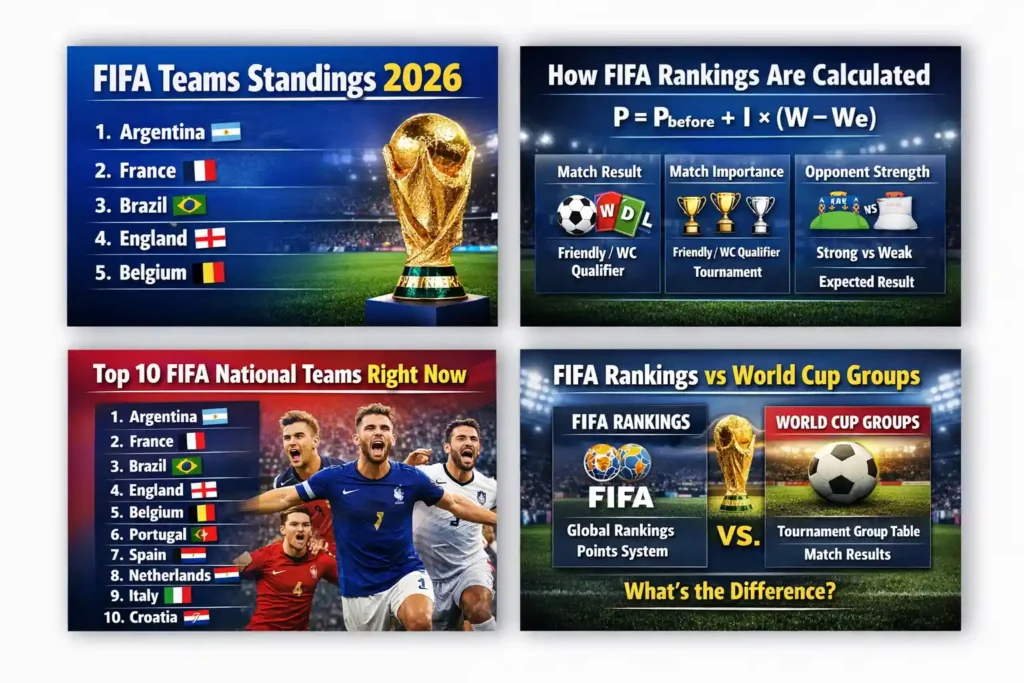
What Are FIFA Teams Standings?
FIFA Teams Standings, also known as FIFA World Rankings, are an official ranking system for men’s and women’s national football teams. The rankings are based on match results, strength of opponents, match importance, and tournament performance.
The men’s ranking system was first introduced in 1993. Over time, the calculation method was improved to make it fairer and more performance-based. Today, FIFA uses the “SUM” ranking system, which adds or subtracts points after each match instead of averaging results over several years.
These standings help determine:
- World Cup seeding
- Qualification group placements
- Tournament draws
- Global football reputation
How FIFA Teams Standings Are Calculated (Points Formula Explained)
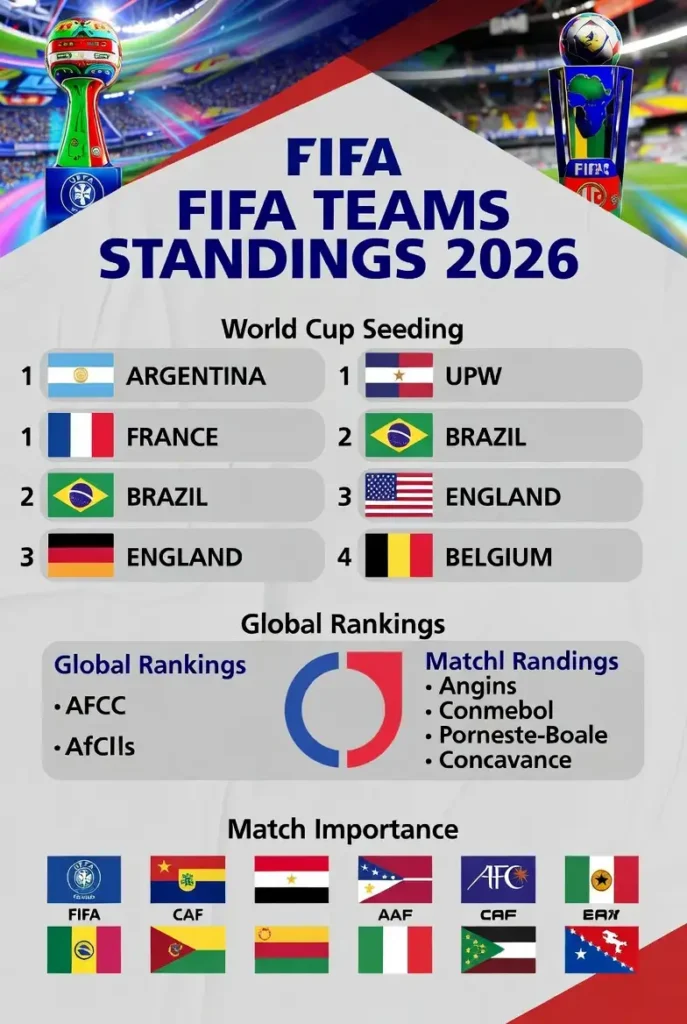
FIFA uses a points-based formula known as the SUM system. After each match, teams gain or lose points depending on:
- Match result (win, draw, loss)
- Match importance (friendly, qualifier, continental tournament, World Cup)
- Strength of the opponent
- Expected result
Basic FIFA Ranking Formula:
P = Pbefore + I × (W – We)
Where:
- Pbefore = Points before match
- I = Importance of match
- W = Actual result
- We = Expected result
Match Importance Values:
- Friendly match: Lower points
- World Cup qualifier: Medium points
- Continental championship: Higher points
- FIFA World Cup match: Highest points
This means winning a World Cup match gives more ranking points than winning a friendly.
Current FIFA Teams Standings 2026 (Latest Update)
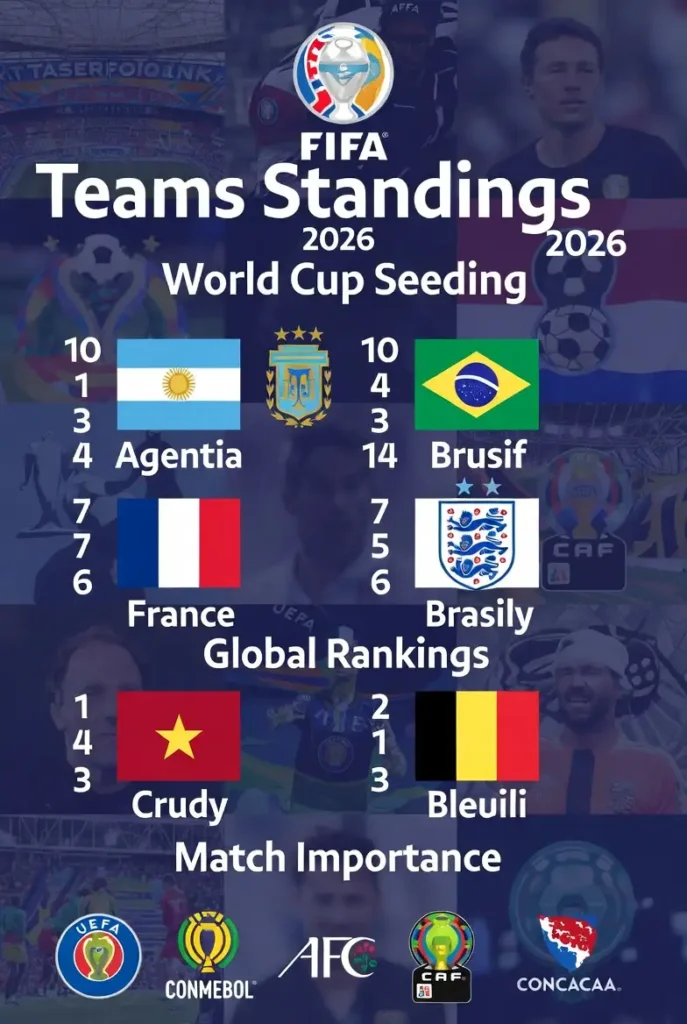
As of the most recent update, the top national teams in the world include:
- Argentina national football team
- France national football team
- Brazil national football team
- England national football team
- Belgium national football team
These rankings change regularly depending on international match results, qualifiers, and tournament performances.
Top 10 FIFA National Teams Right Now
Here’s a breakdown of what makes top-ranked teams strong:
1. Argentina
Strong squad depth, tactical discipline, and World Cup-winning experience.
2. France
Young talent mixed with experienced stars.
3. Brazil
Consistent attacking power and technical quality.
4. England
Strong Premier League-based squad and structured gameplay.
5. Belgium
Golden generation impact and competitive consistency.
Other teams often in the top 10 include Portugal, Netherlands, Spain, Italy, and Croatia.
FIFA Teams Standings and World Cup 2026
The FIFA World Cup 2026 will feature 48 teams for the first time in history. Rankings are crucial for:
- Tournament seeding
- Group stage allocation
- Avoiding strong teams early
Higher-ranked teams are placed in better pots during the World Cup draw. This increases their chances of getting balanced group-stage opponents.
FIFA Continental Rankings (By Confederation)
FIFA rankings also reflect continental performance.
UEFA (Europe)
Includes strong teams like France, England, Spain, Germany, and Portugal.
CONMEBOL (South America)
Brazil and Argentina dominate this region.
AFC (Asia)
Japan, South Korea, Iran, and Australia usually lead.
CAF (Africa)
Morocco, Senegal, and Nigeria are top African sides.
CONCACAF (North & Central America)
USA, Mexico, and Canada lead this confederation.
Continental strength influences global ranking movement during tournaments.
FIFA Teams Standings by Performance Metrics
Rankings are influenced by:
- Total wins
- Goal difference
- Strength of schedule
- Tournament advancement
- Head-to-head records
A team that defeats high-ranked opponents gains more points than beating lower-ranked teams.
Biggest Ranking Improvements in Recent Years
Some teams have made impressive jumps in the FIFA standings:
- Morocco’s rise after strong World Cup performance
- Japan’s consistent improvement in Asian competitions
- Croatia maintaining top status despite squad transition
Meanwhile, teams that fail in qualifiers or major tournaments can drop significantly.
FIFA Women’s Teams Standings
FIFA also maintains official women’s rankings. The system is similar but based on women’s international matches.
Top-ranked women’s teams often include:
- USA
- Germany
- Sweden
- Spain
Women’s rankings impact tournament seedings like the Women’s World Cup.
Historical No.1 Teams in FIFA Rankings
Since 1993, several teams have reached No.1:
- Brazil
- Germany
- Spain
- Belgium
- Argentina
Brazil has historically spent the most time at the top of the rankings.
How Often FIFA Updates Team Rankings?
FIFA updates the rankings multiple times per year, typically after international match windows. Rankings are adjusted immediately after:
- World Cup qualifiers
- Continental tournaments
- International friendlies
Fans can check official updates on the FIFA website.
FIFA Teams Standings vs World Cup Group Tables
Many fans confuse FIFA rankings with tournament group tables.
Here’s the difference:
- FIFA Rankings = Global performance rating over time
- World Cup Group Table = Points earned in a specific tournament
A lower-ranked team can top a World Cup group if they perform well during the tournament.
How FIFA Rankings Impact World Cup Seeding
Rankings determine:
- Pot placement
- Group balance
- Competitive fairness
Top-ranked teams avoid facing other elite teams in early stages.
This system ensures tournament structure is based on performance, not popularity.
Country-Wise FIFA Rankings Overview
Argentina
World champions and consistently ranked near the top.
France
Strong tactical and physical squad depth.
Brazil
Traditionally one of the strongest teams in football history.
England
High consistency in qualifiers and tournaments.
Each country’s ranking reflects long-term performance, not just one tournament.
How to Check Official FIFA Teams Standings Online
To check updated rankings:
- Visit the official FIFA website
- Select Men’s or Women’s rankings
- Filter by date
- Compare points and ranking changes
Always use official sources to avoid outdated information.
Do Friendly Matches Affect FIFA Standings?
Yes, but they carry less weight compared to competitive matches.
- Winning a friendly gives fewer points
- Losing a friendly can still reduce points
- Competitive matches offer higher ranking impact
That’s why teams take qualifiers and tournaments more seriously in terms of rankings.
Why FIFA Teams Standings Matter in Modern Football
FIFA rankings influence:
- Global football perception
- Sponsorship value
- Tournament seeding
- Betting analysis
- Team confidence
For fans and analysts, standings provide a data-driven way to measure team strength.
Frequently Asked Questions (FAQs)
Who is No.1 in FIFA rankings right now?
It changes based on recent results. Currently, Argentina holds a top position in many recent updates.
How are FIFA ranking points calculated?
Using the SUM formula based on match importance and opponent strength.
Do World Cup matches give more points?
Yes, World Cup matches have the highest importance factor.
Which team has been ranked No.1 the most?
Brazil historically holds the longest duration at No.1.
Final Thoughts – The Importance of FIFA Teams Standings in 2026
FIFA Teams Standings are more than just numbers. They reflect performance, consistency, and global dominance in international football. With the expanded 48-team FIFA World Cup 2026, rankings are more important than ever for tournament seeding and competitive balance.
Whether you are a football fan, sports analyst, content creator, or bettor, understanding FIFA rankings gives you a deeper insight into international football performance trends.
As we move closer to 2026, expect major ranking shifts due to qualifiers, continental championships, and friendly tournaments.
Stay updated, follow official sources, and keep tracking the evolution of global football power.
About the Author