Football fans around the world are already excited about the upcoming FIFA World Cup 2026. The tournament will be historic for many reasons, but one of the most exciting changes is the expansion to 48 teams. This new format gives more countries a chance to participate, including nations with small populations that traditionally struggled to qualify.
For many fans, one interesting question is: Smallest Country to Qualify for FIFA World Cup 2026?
With more qualification spots available, smaller football nations now have a realistic opportunity to appear on football’s biggest stage. In this guide, we’ll explore how population affects football success, which small countries could qualify, and the history of the smallest nations ever to reach the World Cup.
What Does “Smallest Country” Mean in Football?
When people talk about the smallest country in football, they usually refer to population size rather than land area. A smaller population means fewer players to choose from, which can make building a competitive national team more difficult. World Cup 2026 favorites and dark horses.
However, population alone does not decide football success. Some countries with fewer than one million people have still managed to compete at the highest level.
There are several reasons why smaller nations can still succeed:
- Strong football development systems
- High participation rates among youth
- Good coaching and tactical organization
- Players gaining experience in foreign leagues
A great example is the Iceland national football team, which shocked the football world by qualifying for the 2018 FIFA World Cup despite having a population of around 370,000 people.
This proves that even small nations can achieve big results with the right strategy.
Why the 2026 World Cup Favors Smaller Nations
The 2026 World Cup will be a turning point for global football. Several major changes are expected to benefit smaller countries.
1. Expansion to 48 Teams
The biggest change is the expansion from 32 teams to 48 teams. This means 16 additional teams will compete in the tournament.
More spots automatically increase the chances for smaller nations that previously struggled during qualification.
2. More Qualification Spots Per Region
Each football confederation will receive additional qualification spots:
- UEFA (Europe) – more direct entries
- CAF (Africa) – significantly increased representation
- CONCACAF – expanded spots due to hosting
- AFC (Asia) – more teams qualifying
- CONMEBOL – easier qualification routes
This change gives emerging football nations a real opportunity to compete globally. FIFA World Cup 2026 fan zones.
3. Growing Football Development Programs
Many smaller countries are investing heavily in football infrastructure, including:
- Modern training facilities
- Youth academies
- Professional coaching systems
These improvements help produce talented players who can compete internationally.
4. Globalization of Football Talent
Today, many players from small countries develop their careers in major European leagues. This experience strengthens national teams and improves their chances in qualification tournaments.
Smallest Countries That Could Qualify for the 2026 World Cup
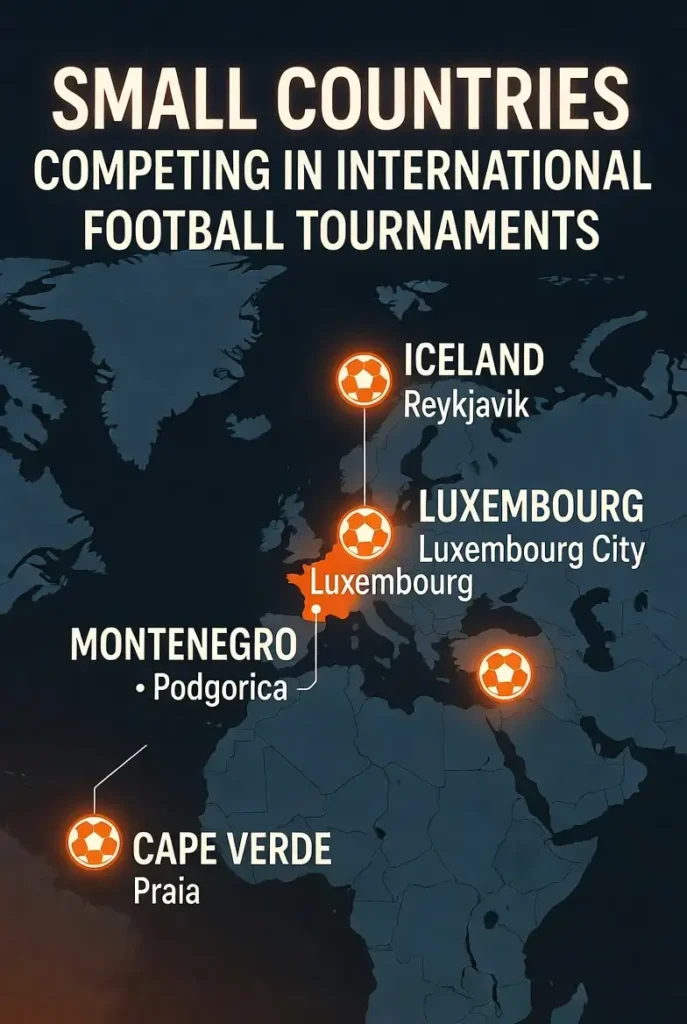
Several small nations have improved dramatically in recent years. These countries could potentially become the Smallest Country to Qualify for FIFA World Cup 2026?
Iceland
Iceland is one of the most famous football underdog stories.
Despite having a population of less than 400,000, Iceland has produced strong teams through excellent youth development. Their qualification for the 2018 FIFA World Cup made them the smallest country ever to reach the tournament.
Their organized playing style and strong team spirit could help them qualify again.
Montenegro
The Montenegro national football team represents a country with a population of around 620,000 people.
Although Montenegro has never qualified for the World Cup, they have shown strong performances in European qualifiers. The team also benefits from talented players competing in top European leagues.
With the expanded World Cup format, Montenegro has a better chance than ever.
Luxembourg
The Luxembourg national football team has improved significantly over the past decade.
Once considered one of Europe’s weakest teams, Luxembourg now competes much more strongly in qualification matches. Their investment in football infrastructure and youth development is starting to produce results.
If their progress continues, they could become one of the smallest nations to qualify for a future World Cup.
Cape Verde
The Cape Verde national football team is one of Africa’s rising football nations.
With a population of just over 500,000 people, Cape Verde has already impressed in African competitions. Many of their players compete in European leagues, bringing valuable experience to the national team.
With more African qualification spots available, Cape Verde could become a surprise qualifier.
Smallest Countries That Have Qualified for the World Cup in History
Historically, only a few small nations have managed to qualify for the World Cup.
Iceland – 2018
Iceland currently holds the record as the smallest nation to ever qualify for a World Cup. Their qualification for the 2018 tournament in Russia captured global attention.
Trinidad and Tobago – 2006
The Trinidad and Tobago national football team qualified for the 2006 FIFA World Cup with a population of around 1.3 million.
Their journey to Germany remains one of the greatest underdog stories in football.
Slovenia
The Slovenia national football team qualified for the 2002 FIFA World Cup and again in 2010. With a population of just over 2 million, Slovenia proved that smaller European nations can compete globally.
These teams show that smart planning, good coaching, and strong teamwork can overcome population disadvantages.
Challenges Small Countries Face in World Cup Qualification
Even with the expanded format, smaller countries still face significant challenges.
Limited Player Pool
A smaller population naturally means fewer players to choose from, which can limit squad depth.
Financial Limitations
Smaller nations often have fewer financial resources to invest in:
- Training facilities
- Youth academies
- Coaching programs
Strong Competition
Many qualification groups include powerful football nations with larger populations and more resources.
Dependence on Diaspora Players
Some smaller nations rely on players with dual nationality who developed their careers abroad.
While this strategy can strengthen teams, it also creates challenges in building long-term football development.

How Small Nations Can Still Compete Globally
Despite these obstacles, several strategies allow smaller nations to succeed.
Youth Development
Investing in youth academies ensures a steady supply of talented players for the national team.
Tactical Discipline
Smaller teams often rely on strong defensive organization and tactical discipline to compete with stronger opponents.
Smart Scouting
Recruiting players with dual nationality can significantly strengthen a national squad.
Grassroots Football Investment
Encouraging football participation at the grassroots level increases the number of potential players.
These strategies helped teams like Iceland achieve historic success.
Could the Smallest Country Ever Play in the 2026 World Cup?
With the expansion to 48 teams, the 2026 tournament could feature the smallest nation in World Cup history.
Smaller football countries now have a realistic chance of qualifying thanks to:
- Additional tournament spots
- Improved development systems
- Greater global football exposure
Fans also love underdog stories. When smaller nations compete against football giants, it creates some of the most exciting moments in World Cup history.
Key Takeaways
- The 2026 World Cup will feature 48 teams, increasing opportunities for smaller nations.
- Countries with small populations can still succeed through strong development programs.
- Iceland currently holds the record as the smallest country to qualify for a World Cup.
- Nations like Montenegro, Luxembourg, and Cape Verde could become the next small-country success stories.
- The expanded tournament format may produce new football underdogs on the world stage.
FAQs
The Iceland national football team is the smallest country to ever qualify for a World Cup, reaching the 2018 FIFA World Cup.
The FIFA World Cup 2026 will feature 48 teams, making it the largest World Cup in history.
Yes. The expanded tournament format and additional qualification spots give smaller nations a better chance to qualify.
Countries like Iceland, Montenegro, Luxembourg, and Cape Verde are among the smaller nations that could potentially qualify for the 2026 World Cup.
About the Author