The road to the FIFA World Cup 2026 is already full of drama, excitement, and uncertainty but one storyline is dominating every football conversation: injuries. As national teams prepare for the biggest tournament in football history, injury concerns are becoming a major threat to dreams, tactics, and even championship predictions.
With the tournament expanding to 48 teams and a packed international football calendar, players are under more pressure than ever. Club competitions, continental tournaments, and nonstop travel are pushing elite athletes to their physical limits. As a result, even minor injuries can turn into major setbacks. For fans, this means one thing: the final squad lists for World Cup 2026 may look very different from what we expect today.
Why Injuries Could Define FIFA World Cup 2026
In modern football, injuries are not just random setbacks they are tournament-changing events. The FIFA World Cup 2026 is expected to be one of the most physically demanding editions in history for several reasons. First, the expansion to 48 teams means more matches and higher competition intensity. Players will already arrive at the tournament after exhausting club seasons in Europe, South America, and Asia.
Second, the schedule pressure is extreme. Many players participate in domestic leagues, Champions League fixtures, international qualifiers, and continental tournaments like the Copa América and UEFA Euro qualifiers in the same cycle. Finally, the lack of rest between seasons is increasing muscle fatigue, which is one of the biggest causes of recurring injuries in elite football. In simple terms: the team with the healthiest squad may have a huge advantage in 2026.
Biggest Football Stars Currently Battling Injuries
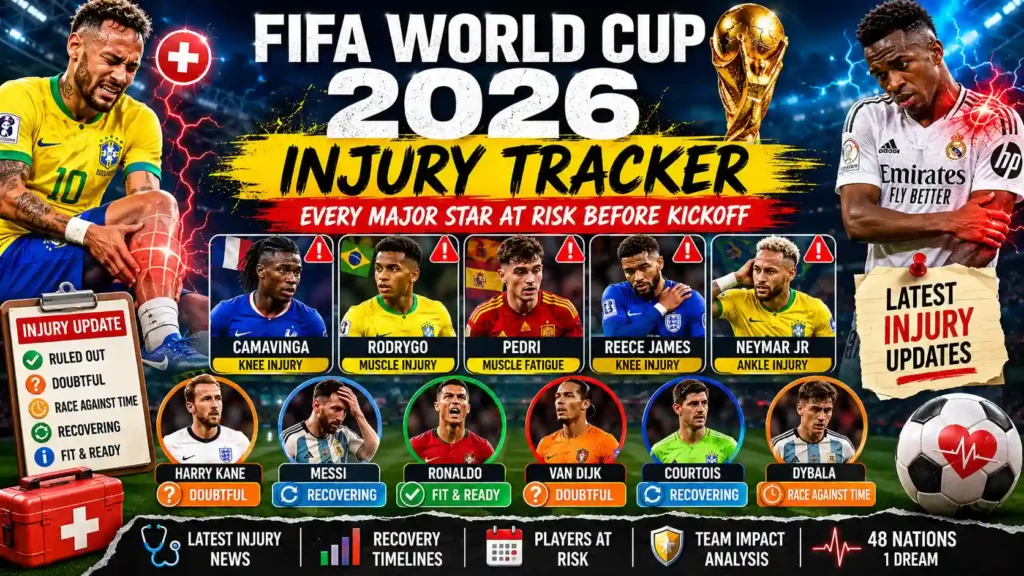
Neymar Jr – Brazil’s Constant Fitness Concern
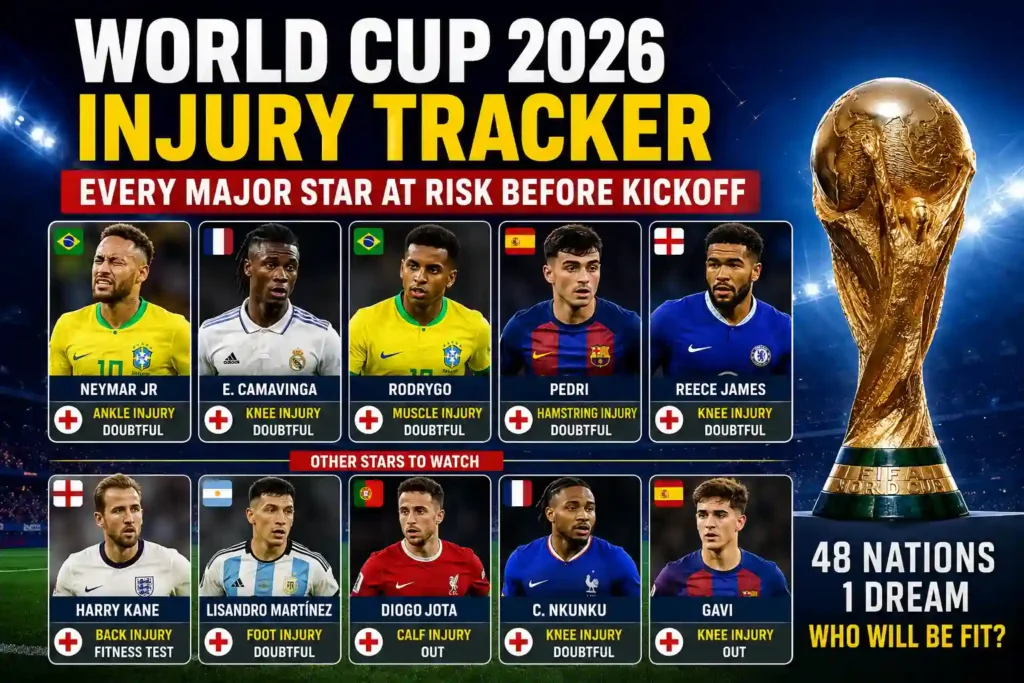
Neymar remains one of the most talented players in world football, but his injury record is becoming a serious concern for Brazil. Over the past few years, he has struggled with ankle injuries and muscle issues that have kept him out of key matches.
Heading into 2026, Brazil’s hopes still depend heavily on his creativity, but his availability remains uncertain. Even when he returns, questions remain about whether he can maintain full fitness throughout a high-intensity tournament.
Eduardo Camavinga – France’s Midfield Engine Under Pressure
Eduardo Camavinga has become a key figure in France’s midfield setup. However, his recent injury concerns have raised questions about his long-term durability.
France relies on his energy, passing range, and defensive support. If he struggles with fitness leading into 2026, it could force the coaching staff to rethink their midfield structure entirely.
Rodrygo – Brazil’s Attacking Depth at Risk
Rodrygo’s development at club level has been impressive, but injury interruptions have slowed his consistency. As part of Brazil’s attacking unit, his ability to play wide and centrally makes him extremely valuable.
Any injury setback for him before the World Cup would significantly reduce Brazil’s attacking flexibility.
Pedri – Spain’s Creative Midfield Hope
Pedri is one of Spain’s most important young players, but his body has already shown signs of fatigue due to heavy playing time at a young age.
Spain’s entire tactical system depends on his control in midfield. Without him at full fitness, Spain may struggle to maintain possession dominance against top-tier opponents.
Reece James – England’s Defensive Doubts
England’s defensive setup has been heavily impacted by Reece James’ recurring injury issues. When fit, he is one of the best attacking full-backs in the world.
However, his availability remains unpredictable. England’s coaching staff will need backup plans in case he is not fully ready for World Cup 2026.
Players Ruled Out or Facing Serious Doubts
As the tournament approaches, some players may not recover in time from long-term injuries such as ACL tears, ligament damage, or repeated muscle injuries.
ACL injuries are particularly dangerous because recovery often takes 6–12 months, and even after recovery, players may not return to peak performance immediately.
Other players facing doubts include those with recurring hamstring injuries or chronic ankle problems. These types of injuries are especially risky in a tournament format where matches come every few days.
Countries Most Affected by Injury Problems
Brazil – Constant Injury Pressure
Brazil has one of the deepest squads in the world, but many of its attacking stars have struggled with injuries. If key forwards are not fit, Brazil may lose its attacking identity.
France – Midfield Depth Concerns
France traditionally has strong squad depth, but injuries in midfield could force tactical reshuffles. The balance between attack and defense depends heavily on player fitness.
England – Defensive Instability
England’s backline has been inconsistent due to injuries in recent years. Full fitness across defenders will be crucial for their chances in 2026.
Argentina – Managing Veteran Fitness
Argentina’s success in recent tournaments has depended on experienced players. Managing their workload before 2026 will be a major challenge.
Portugal – Aging Stars and Fitness Management
Portugal faces a unique challenge: balancing young talent with aging superstars who may struggle with physical demands of a long tournament.
How Injuries Could Change World Cup 2026 Predictions
Injuries can completely transform tournament predictions. A team that looks like a favorite today may lose its advantage if even one or two key players are ruled out.
For example:
- A missing striker can reduce goal-scoring power
- A missing midfielder can break team balance
- A missing defender can weaken tactical stability
This creates opportunities for underdog nations, who may face weakened top teams during knockout stages.
Young Players Ready to Replace Injured Superstars
If injuries continue to impact squads, younger players will get their moment on the world stage.
Lamine Yamal
One of the most exciting young talents in world football, capable of changing matches with creativity and pace.
Endrick
A rising Brazilian forward expected to become a major attacking option for Brazil.
Kobbie Mainoo
A technically gifted midfielder who could play a key role for England.
Warren Zaïre-Emery
A powerful and intelligent midfielder representing the future of France’s midfield.
Modern Football’s Injury Problem Explained
The increase in injuries is not random—it is a result of modern football demands.
Key reasons include:
- Too many matches per season
- Reduced recovery time between games
- Increased travel across continents
- High-intensity pressing tactics
- Expanded international tournaments
Sports science has improved recovery methods, but it has not fully solved the problem of overload.
Which Injuries Are Most Dangerous Before a World Cup?
Some injuries are more serious than others when it comes to tournament readiness:
- ACL tears: long recovery and risk of re-injury
- Hamstring injuries: high chance of recurrence
- Ankle ligament damage: affects mobility and balance
- Muscle fatigue injuries: unpredictable and recurring
These injuries often determine whether a player can realistically participate in the World Cup.
Latest Recovery Timelines of Major Stars
Recovery timelines vary depending on injury type and severity. Minor muscle injuries may require weeks, while ligament injuries can take months.
The biggest concern for coaches is not just recovery but match fitness. Even if a player returns before the tournament, they may lack rhythm and sharpness.Fans’ Biggest Concerns Ahead of FIFA World Cup 2026
Fans around the world are increasingly worried that injuries could take away the biggest names from the tournament. Social media debates often focus on questions like:
- Will superstar players recover in time?
- Which team is most affected by injuries?
- Who will replace injured stars?
This uncertainty adds drama but also anxiety to the buildup.
Could Injuries Decide the FIFA World Cup 2026 Winner?
History shows that injuries often play a silent but powerful role in World Cup outcomes. Teams that arrive with fully fit squads usually perform better in knockout stages.
Even one missing superstar can change:
- Team tactics
- Scoring ability
- Defensive stability
- Leadership on the field
So yes injuries could absolutely decide who lifts the trophy in 2026.
Conclusion
The FIFA World Cup 2026 is shaping up to be one of the most competitive tournaments in football history, but injuries remain the biggest unpredictable factor.
From Neymar’s fitness concerns to Europe’s rising stars battling fatigue, every nation is monitoring player health closely. As kickoff approaches, the real battle may not just be on the pitch—but in recovery rooms, medical reports, and training grounds.
One thing is clear: the World Cup 2026 Injury Tracker will remain one of the most important stories leading into football’s greatest stage.
About the Author